You can get to the door of a Japanese bathhouse, towel in hand, and be turned away over a tattoo the size of a coin. It is a common enough experience that it puts people off hot springs entirely, which is a shame, because the situation is far more workable than the blanket rule suggests. There are three separate routes in, and at least one of them works for almost everybody. Our onsen guide covers the bathing etiquette itself; this one is about getting through the door.
Why the rule exists
The ban is not about you. Tattoos in Japan carried an association with organised crime for decades, and bathhouses responded with a blanket prohibition because it is administratively simpler than assessing each guest individually. The sign at the entrance is usually a small pictogram with a line through it, and staff applying it are following a house rule rather than passing judgement.
Two things follow from that. Because it is a house rule and not a law, it varies enormously between venues, and because it varies, the only reliable information is the policy of the specific place you intend to visit. The trend across the country is towards loosening, especially at newer facilities and those accustomed to international visitors, but there is no national standard and no central register.
Route one: find a place that allows them
The most straightforward approach is to sort the problem out before you arrive.
Search for the policy directly. Searching the town name together with the phrase tattoo friendly onsen turns up traveller maintained lists for most popular areas. These are useful for shortlisting but not authoritative, because policies change and lists go stale.
Look at hotel baths. Large modern hotels with their own hot spring facilities, particularly international chains and city properties, tend to be considerably more relaxed than a traditional bathhouse in a village.
Ask. It is the least comfortable option and by far the most reliable. An email before the trip, or a single question at reception, resolves it in seconds. A short sentence is enough: you have a small tattoo, is that acceptable.
Route two: cover stickers, and their limits
Skin coloured cover patches are sold widely in Japanese drugstores and variety shops, and they exist precisely for this purpose. They work, with conditions attached.
They only work on small tattoos, roughly the size of a credit card or less. A sleeve or a back piece cannot be hidden and there is no point attempting it. Buy a waterproof one and press it down properly, because hot water and steam will find a loose edge. And understand what the sticker is really doing: the operating principle at most venues is that a tattoo which cannot be seen is not a problem. A patch that floats free in a crowded pool is a worse outcome than not using one at all.
Route three: private baths, which solve it completely
For anyone whose tattoos are too large for a sticker, this is the answer, and it is a better experience than the workaround it replaces.
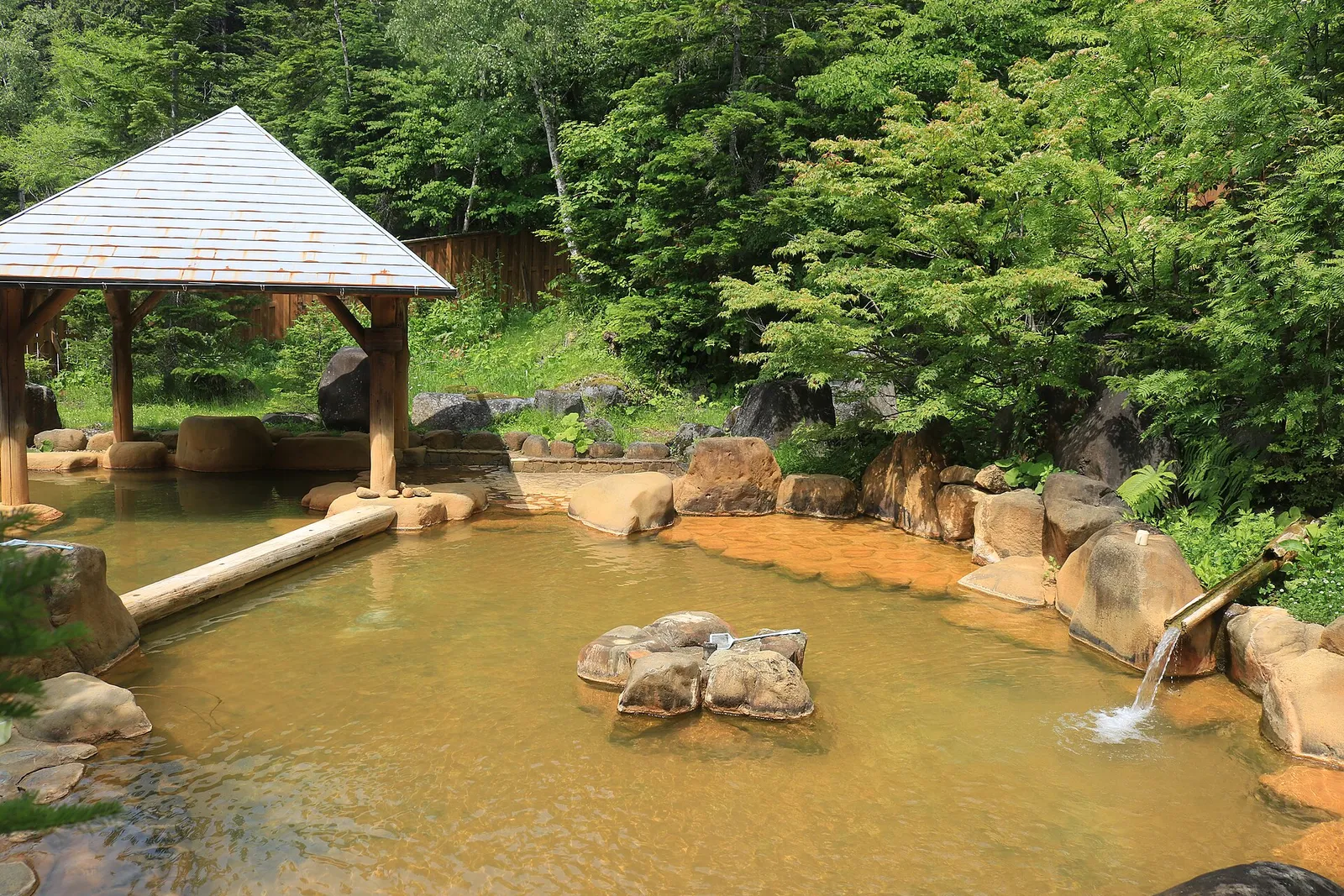
Kashikiri baths are private baths inside a larger facility, reserved for your group for a set period and charged on top of admission. Plenty of bathhouses that prohibit tattoos in the communal pools rent these without a second thought.
Rooms with a private bath attached go one step further: the hot spring is on your balcony or in your bathroom, available at any hour, with nobody to ask. This is a distinct and more expensive room category rather than a standard feature, so filter for it when booking. Our ryokan guide explains what that style of stay involves more generally, and in an onsen area like Hakone these rooms are common enough to choose between.
Sento and super sento are a different category
Not every bath in Japan is an onsen, and the distinction is useful here.
An onsen draws naturally heated mineral water from the ground and is the thing people travel for. A sento is a neighbourhood public bathhouse heated conventionally, historically used by people whose homes had no bath. A super sento is the modern bathing complex version, often on the edge of a city, with several pools, a sauna, a restaurant and a rest area.
For tattooed visitors the practical point is that these categories tend to have different attitudes. The large modern complexes are used to a broad public and are frequently the most relaxed option in a given city, while a small traditional neighbourhood bathhouse can be the strictest place in town. Neither rule is reliable enough to act on without checking, but if you are looking for somewhere to try first, the modern complex is usually the better bet.
Choosing between the three
Match the route to the tattoo rather than to the budget. A small, easily covered tattoo gives you all three options, and the sticker is the cheapest way to walk into an ordinary bathhouse. A large or awkwardly placed one narrows it to the private bath, either by the hour or by the room.
Whichever route you take, the ordinary rules still apply once you are in the water. Wash thoroughly at the taps before entering, bathe without swimwear, and keep the small towel out of the pool. Admission to a public bath is usually modest and quoted in yen; a private bath by the hour costs more, and a room with its own is a different price bracket again. Confirm current rates with the venue rather than relying on a figure quoted anywhere, including here.